I Deleted My Zettelkasten
I’m currently deleting my Zettelkasten. Not archiving it, not reorganizing it - actually deleting it. And I feel… resistance. Which is fascinating, because I haven’t opened most of these notes in months.
Let me tell you about a system I built with the best intentions, and why it completely failed.
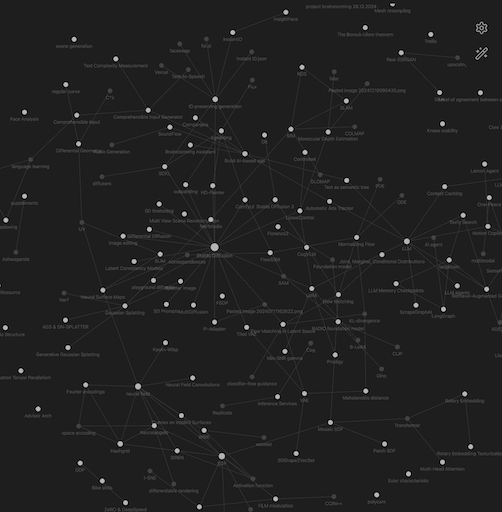
My Zettelkasten graph
The Seduction
A few years ago, I discovered Zettelkasten from this video. The promise was intoxicating: build a “second brain” where knowledge compounds over time. Create atomic notes, link them together, and watch unexpected insights emerge from the connections. Your future self will thank you.
I was working in ML, constantly learning new things - sota frameworks, new architectures, optimization techniques. The field moves fast. Surely I needed a system to organize all this knowledge?
So I built one in Obsidian. I liked the idea of the graph, the connections, the structure. For a while, it felt productive. I’d read about some technique, write a note, link it to related concepts. My graph grew. It looked impressive.
The Reality
Here’s what actually happened:
I wrote constantly. I read almost never.
My Zettelkasten became write-only memory. I’d capture information, organize it beautifully, add it to the graph… and never look at it again.
Right now I can open Obsidian and see a cluster about “Stable Diffusion” with nodes for SD3, flow matching, various techniques. And I think: “Okay, so what?” What am I supposed to do with this? When would I ever browse this graph instead of just Googling what I need?

Stable Diffusion node
The honest truth: the act of writing the note was the value. The note itself was theater.
Why This Happens
Writing forces you to organize fuzzy understanding into clear structure. It helps you identify gaps. It creates mental anchors. But once it’s written?
For technical ML content, the half-life is 6-18 months before it’s outdated. My “Stable Diffusion” notes are probably already antiquated. Better frameworks exist. The field moved on.
But here’s the deeper issue: I fell in love with the idea of the system more than the system itself.
The seductive promise: “I’m building this interconnected web of knowledge where unexpected insights will emerge!”
The reality: A large, noisy graph I don’t actually navigate.
What I’m Learning
When I abandoned Zettelkasten for a period, nothing broke. I survived. I learned things anyway. The notes I “needed” never came up because:
- Critical knowledge sticks through use, not through note-taking
- Everything else is Google-able when you need it
- Re-learning something when you need it often works better than retrieving a stale note
The brutal question I finally asked myself: “If I deleted this entire graph tomorrow, what would I actually miss?”
Answer: Maybe 5-10 notes. Everything else is archaeological record of past learning that served its purpose at the time of writing.
The Real Problem
I was optimizing for capture when I should have been optimizing for use.
Zettelkasten optimizes for: “Store everything, connect everything, insights will emerge”
What I actually needed: “Remember the stuff that matters through doing real work”
The note-taking became productive procrastination. It felt like learning, like building something permanent. But it was just… organizing. The satisfaction came from the system, not from the knowledge work itself.
What Actually Works
I still take notes when learning something new. But now they’re:
- Attached to actual projects - not floating in abstract knowledge space
- Dated and contextual - “What I learned debugging this specific issue”
- Disposable - I don’t pretend they’ll be relevant in 6 months
- Minimal - Only what I actually need to remember
The exception: original ideas. If I have an insight that’s genuinely mine - a connection I made, a problem I solved in a novel way, something I can’t just Google later - those get captured. But that’s maybe 5% of what I was storing. The other 95% was just regurgitating what already exists on the internet.
The Uncomfortable Truth
Most technical knowledge doesn’t need to be “managed.” It needs to be:
- Used (so it sticks)
- Or forgotten (so you can re-learn it better when you actually need it)
The internet is my extended memory for everything else. That’s fine.
The hardest part of deleting my Zettelkasten isn’t losing the knowledge - it’s admitting I was in love with an aspirational tool, not a functional one. I was building infrastructure for a fantasy instead of just doing the work.
If You’re Reading This With Your Own Zettelkasten
Ask yourself honestly:
- When did you last browse your notes for insight?
- How many notes have you read more than once?
- If you deleted it tomorrow, would your actual work suffer?
If the answers make you uncomfortable, you might be building the same fantasy I was.
The graph is beautiful. The connections are satisfying to create. But beauty and satisfaction aren’t the same as utility.
I’m still deleting notes as I write this. It’s getting easier.